

The current US executive’s attack on the top officials of the Federal Reserve is a sharp affront to decades of hard-won wisdom in central banking—wisdom painstakingly gained through policy errors and inflationary crises, and also credited with delivering stable and prosperous economies. The wave of politisation now threatens the monetary credibility of the US and the dollar’s dominant reserve currency status. It is therefore tempting to question what might be the implications for the universe of crypto assets, a large part of which is built on that foundation.
Looking back: Central bank independence as an anti-inflation tool
The movement to make central banks independent took shape in the twentieth century, driven by hard lessons from spiraling inflation—most infamously in the 1970s—when government interference in monetary policy led to considerable macroeconomic costs. Influential central banking scholars and practitioners such as Alesina, Summers, and Cukierman showed nearly perfect negative correlations between central bank independence and inflation in advanced economies. These findings brought about what the ECB’s Lamfalussy would later call a “sea change” in monetary policymaking: Over 80% of the world’s central banks won operational independence and the fight against inflation became their explicit, legally protected aim by the turn of the millennium.
Such credibility was neither quickly gained nor easily maintained: Latin American countries, for example, suffered for nearly fifty years—from the collapse of the gold standard to the hyperinflationary 1980s—before finally embracing true operational autonomy for their central banks, achieving dramatic reductions in inflation and macroeconomic instability as a result. Price stability was achieved and sustained once central banks were insulated from short-term political agenda and prevented from monetizing fiscal deficits. Notably, Latin American history also suggests that granting central bank independence with an explicit price stability mandate produces superior long-term outcomes in taming inflation compared to simply pegging the domestic currency to the US dollar.
Why the US current executive’s actions are uniquely worrying
The ongoing public attacks by the US executive on Federal Reserve officials resurrect the specter of government encroachment on monetary policy and herald a dangerous regression to the “bad old days” where political motives dictated money supply decisions. These acts strike directly at the core of a proven institutional anti-inflation legacy.
History illustrates the grave consequences of weakened central bank autonomy. Outcomes like high inflation, capital flight, eroded market confidence, unsustainable government debt spirals, and rising inequality often follow. While such a severe scenario remains unlikely in the US due to its relatively strong institutions, subtler yet impactful repercussions may emerge within global traditional and crypto financial markets. This is especially true regarding pegged crypto assets—digital tokens designed to maintain stable value by linking to traditional assets, commonly fiat currencies or commodities like gold.
The US dollar: Anchor of the crypto asset universe
Confidence in the US dollar as the global reserve currency fundamentally hinges on trust in the long-term credibility and independence of US monetary policy. Threats to this trust intensify not only the likelihood of shifts in actual reserve holdings but also the broader transformation of global financial architecture, including the rising ecosystem of crypto assets. Growth in pegged crypto asset segments particularly depends on the dollar’s anchor status.
Research substantiates that stablecoins themselves do not generate credibility. Instead, they borrow reputation from their underlying fiat references, most often the US dollar. Consequently, their stability—and potentially that of the wider crypto ecosystem—erodes in parallel with growing doubts about the anchor currency’s institutional robustness.
Research at the Fundação Getúlio Vargas in São Paulo (“Stablecoins are not robust anchors”) draws a vital distinction between safe haven assets and anchor assets—terms frequently conflated in financial stability discussions. An anchor asset provides persistent, dependable stability across varying conditions, akin to a ship’s anchor steadily securing a vessel. Meanwhile, a safe haven asset offers temporary shelter during times of market volatility but lacks consistent grounding. The research confirms that while US dollar–pegged stablecoins outperform unpegged cryptocurrencies in turbulence, they fail to exceed traditional fiat currencies in stability, independence, or resilience. Stablecoins lack the consistent, long-term stability essential to true anchor assets.
A role not guaranteed to last indefinitely
The so-called digital currency arms race is a competition that extends beyond mere technological adoption. It is a pivotal struggle over which nation’s monetary instruments will serve as the digital-era anchors. The U.S. dollar’s dominance as the world’s primary reserve currency and its widespread use in stablecoins is not guaranteed to last indefinitely.
For example, China’s advancements in central bank digital currencies (CBDCs) and payment infrastructures signal a deliberate challenge to the dollar’s supremacy. The chart below underscores the dominance of USD-pegged stablecoins. But as US dollar credibility erodes, the share of non-dollar pegs—potentially including the digital yuan, euro, or commodities like gold—could increase.
A case for scrutinising crypto flows
Thus, looking ahead, the flows within crypto asset markets provide a unique real-time laboratory to explore what constitutes a true anchor asset in a hybrid global financial system bridging traditional and innovative crypto elements. The highly fluid crypto space—with competing pegged (and unpegged) assets striving for stability, trust and market share—will reveal how views on suitable anchors will evolve post this recent attack on US monetary institutions.
Monetary policy, traditional financial markets, and stablecoins intertwine in complex and multifaceted ways, and the credibility of monetary policy shapes the transmission channels profoundly. Robust statutory independence, transparency, and clarity of mandate for central banks are not mere historical footnotes; they are essential guardrails enabling monetary policy to withstand political business cycles and maintain public trust. Eroding that legacy threatens to destabilize the global financial system profoundly. The question looms large: will the US dollar continue to serve as the anchor asset it historically has been, or will it reduce to merely a safe haven asset? Current US executive actions cast significant doubt on this assumption of unquestioned global anchoring.
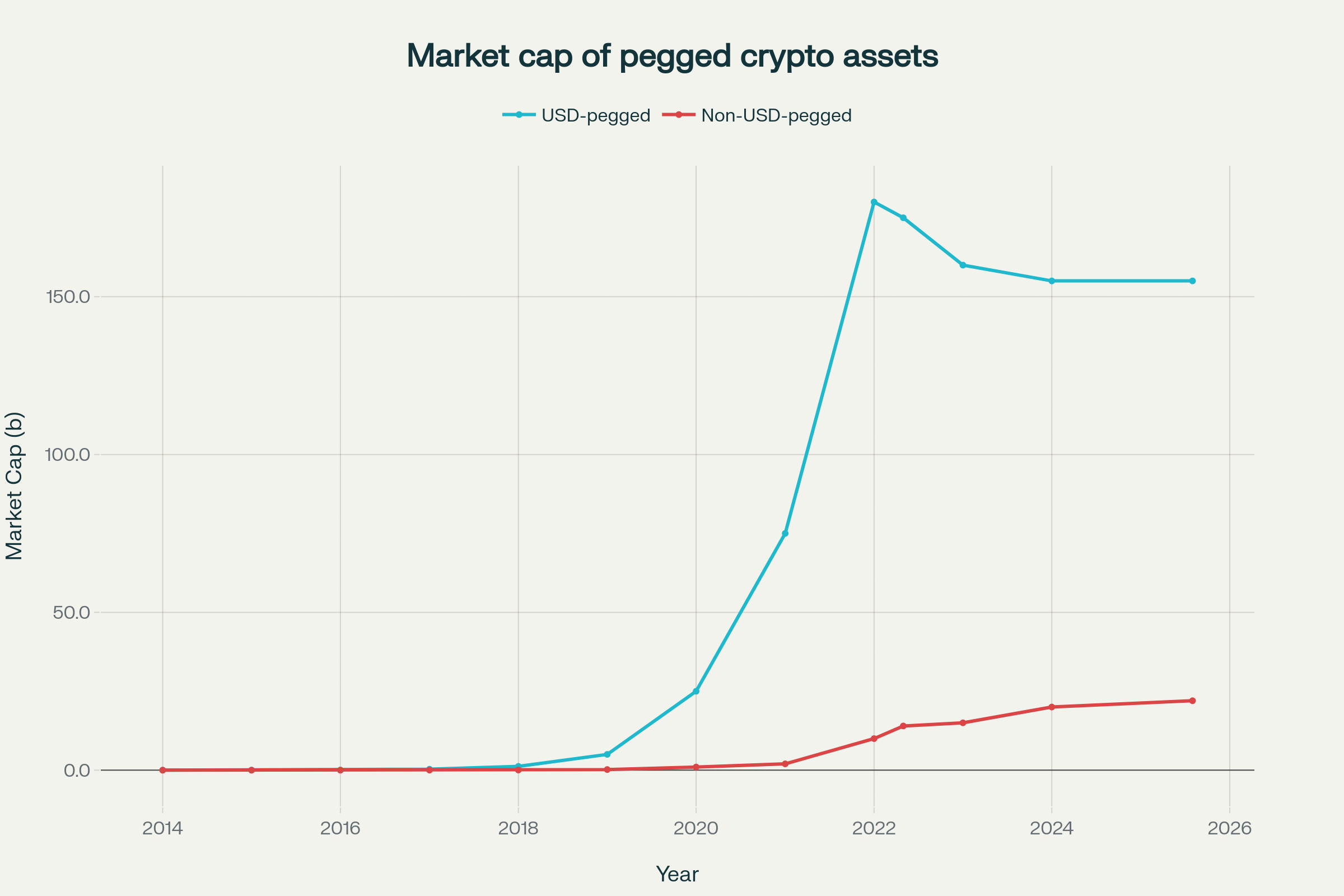
Note: Estimates in US dollar billions. CoinDesk Market Data (https://data.coindesk.com) and DefiLlama Stablecoins Dashboard (https://defillama.com/stablecoins), with historical snapshots compiled and visualized by the author with the help of AI tool Perplexity.